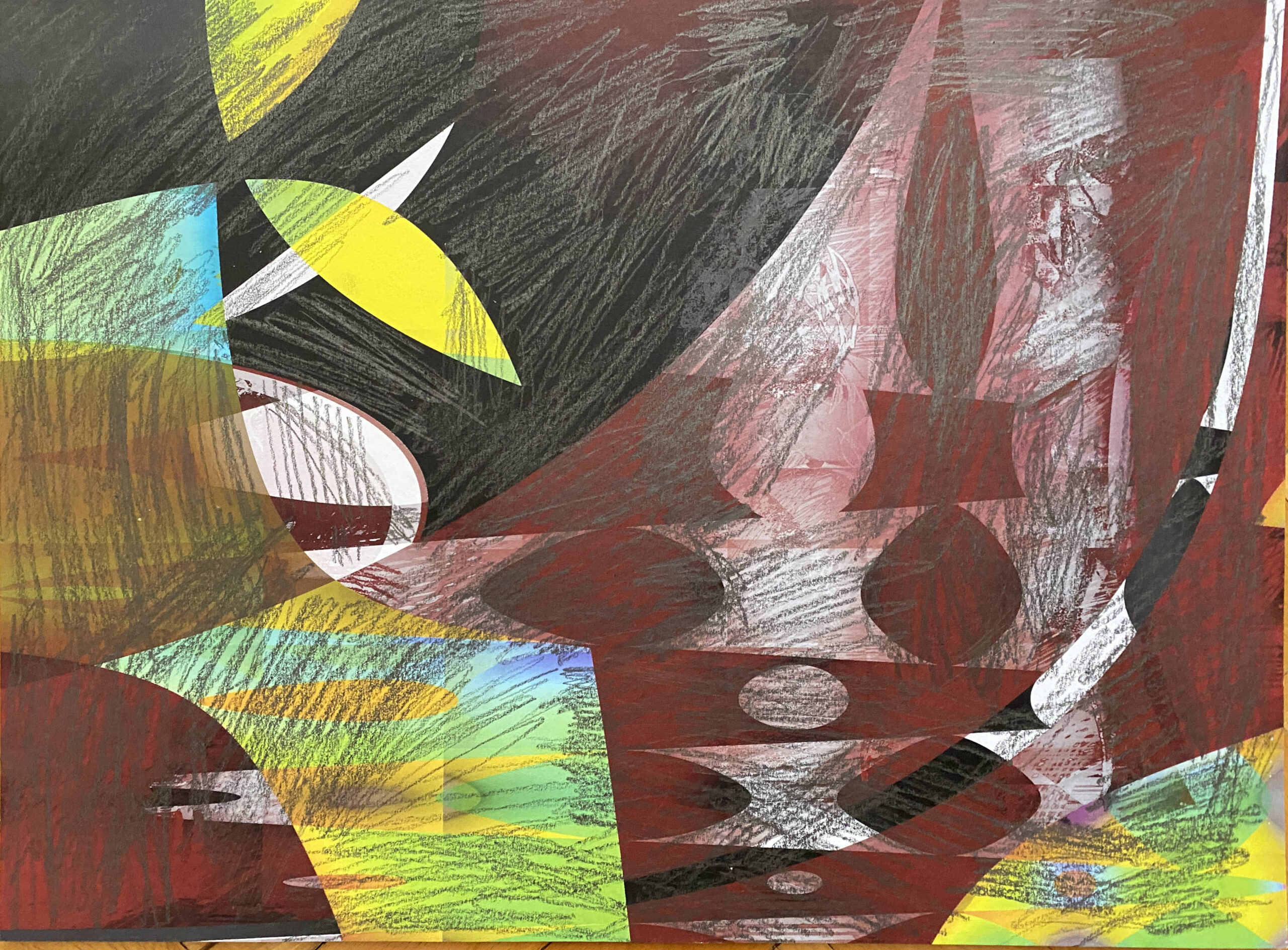
Hatching (No. 06)
- Title: Hatching
- Series: Aperture Set 1
- Artist: ZT Tosha
- Medium: Fine art print on Hahnemühle Photo Rag paper (40×30 cm), with extensive intervention using 7B and 9B graphite pencils; mounted on white mat paper and board; framed in black profile (50×40 cm).
- Year: 2026
Critical Overview: The Violence of the Hand
If Cell (No. 05) was the cycle’s moment of luminous, organic quietude, then Hatching (No. 06) represents a violent rupture in temperament. It is the Aperture series’ most aggressive, kinetic, and physically demanding work—a piece that abandons the fluidity of watercolor in favor of the raw, abrasive texture of dry graphite.
The title is deliberately technical, drawn from the classical drawing technique of hatching—the use of closely spaced parallel lines to create tonal variation and texture. Yet, the artist does not employ this technique with the precision of a Renaissance master; he employs it with the frenetic energy of a seismograph, capturing the vibrations of an agitated hand. The result is a work that feels less like a composed image and more like a physical record of a restless, urgent studio practice.
Materiality: The Architectural Underlay
Beneath the dense layer of graphite, there exists a printed architectural underlay—a fragmented grid of translucent rectangular blocks in shades of deep burgundy, muted ochre, and pale cyan. These blocks are not solid; they are semi-transparent, allowing the underlying print to bleed through.
This underlying grid provides a structural skeleton for the composition. It suggests a blueprint, an architectural plan, or a faded schematic—the remnants of an ordered system that has been violently overlaid by the artist’s hand. The tension between the rigid geometry of the print and the chaotic scribbling of the graphite creates a profound visual friction.
The Graphite Assault: 7B and 9B
The dominant visual element of Hatching is the dense, relentless overlay of graphite—applied using 7B and 9B pencils, the softest, darkest grades of graphite available.
The 7B pencil provides a deep, velvety blackness, creating heavy, sweeping masses of shadow. The 9B pencil, even softer, leaves a thick, smudged, and somewhat glossy deposit that catches the light in uneven patches.
The application is not careful or precise. It is frenetic, aggressive, and undisciplined:
- The Black Mass: A large, sweeping arc of dense graphite dominates the upper-left quadrant, descending like a storm cloud or a tendril of smoke. The direction of the strokes is deliberately chaotic, crisscrossing and overlapping to create a dense, impenetrable void.
- The Horizontal Scratchings: In the lower-left and lower-right quadrants, the graphite is applied in rapid, horizontal swipes, creating a textured, vibrating field of grey. These scratches evoke the static of a disrupted transmission or the frantic scratches of a trapped insect.
- The White Interruptions: Piercing through the dense graphite masses are sharp, geometric white shapes—a yellow crescent, a white arc, and various angular cut-outs. These shapes act as visual anchors, pulling the eye out of the chaotic scratching and providing moments of clarity amidst the noise.
The Cut-Outs: The Breach in the Static
Interspersed throughout the composition are several physical cut-outs: circular, oval, and rectangular voids that expose the pristine white backing of the mat beneath.
These cut-outs are not decorative; they are ventilations. They allow the sterile white of the mat to bleed through the dense, gritty surface, creating a visual and conceptual release from the suffocating pressure of the graphite. In a piece defined by its density and aggression, these small, precise holes offer the viewer a moment of respite—a reminder that even amidst the chaos, there is an aperture, an opening, a way out.
The Framing Strategy: The White Mat as a Containment Vessel
As with the entire Aperture series, Hatching is presented within a crisp white mat and a uniform 50×40 cm black frame.
The white mat is essential to this piece. Because the artwork itself is so dense, dark, and aggressive, the mat serves as a sterile container—a clinical frame that isolates the chaos and prevents it from bleeding into the viewer’s space. It transforms the frenetic scratching into a preserved specimen, a document of a manic impulse pinned and displayed within a museum vitrine.
Critical Honesty: The Dependence on Light and Texture
A rigorous curatorial assessment must acknowledge that Hatching is fundamentally dependent on its lighting conditions and the physical reality of the graphite.
Graphite is a reflective medium. The 7B and 9B pencils leave a deposit that, under flat, diffuse overhead lighting, will appear as a flat, muddy gray mass. To activate the full visual spectrum of the work, the piece demands directional, angled spotlighting (at approximately 45 degrees). This angled light will catch the physical ridges of the graphite strokes, revealing the directionality of the hand and the depth of the overlapping layers.
Furthermore, graphite is physically fragile. The 9B pencil, in particular, leaves a thick deposit that is susceptible to smudging, smearing, and displacement if the surface is touched. For Hatching to achieve its full curatorial potential within a museum context, it is non-negotiable that the framing incorporates museum-grade, UV-filtering anti-reflective glass. This glass will not only protect the fragile graphite from environmental damage, but will also eliminate glare, allowing the viewer to appreciate the full, gritty texture of the surface.
The Role of the Piece in the Series (No. 06)
Positioned as No. 06 within the Aperture cycle, Hatching serves as a critical energizing force. It follows the delicate, translucent quietude of Cell (No. 05) and precedes the heavy, metallic precision of Tailoring (No. 07).
It is the piece that breaks the tension. After the careful obscuration of Occlusion and the fragile beauty of Cell, Hatching injects a shot of raw, untamed energy into the cycle. It reminds the viewer that the Aperture series is not merely a study in precision and materiality, but also a meditation on the human hand—its urgency, its restlessness, and its capacity for both violence and expression.
Conclusion: The Seismograph of the Hand
Hatching is a work of raw, unfiltered energy. It does not seek to be beautiful or refined; it seeks to be felt. The dense, aggressive scratching of the 7B and 9B pencils captures the physical act of drawing in its most primal form—the friction of graphite against paper, the pressure of the hand, the urgency of the gesture.
The cut-outs, the geometric white interruptions, and the underlying architectural grid provide moments of structural clarity, but the true power of the piece lies in its relentless, unapologetic chaos. It is a work that celebrates the act of drawing itself, in all its messy, imperfect, and exhilarating glory.
Acquisition Recommendation: Accepted.
Recommended display: Isolated on a neutral white or light-grey wall, illuminated by directional, angled gallery spotlights (800–1000 lux) to emphasize the physical ridges of the graphite strokes. Museum-grade anti-reflective glass is strictly mandatory to protect the fragile graphite from smudging and to reveal the full, gritty texture of the surface.
