OPUS: THE ASSEMBLER
ARTWORKS · Sculpture · Mixed Media · Painting · 2024–2026
OPUS: THE ASSEMBLER
Across sculpture and installation, ZT Tosha investigates how forms are constructed, held together and altered by the forces acting upon them. His works often begin with a structural proposition and develop through tension between opposing conditions: weight and support, rigidity and flexibility, enclosure and exposure, order and deformation.
*OPUS: THE ASSEMBLER* brings these concerns into a sustained sculptural investigation. The works are constructed from steel, aluminum, fiberglass, resin and tensioned textile, combining engineered armatures with surfaces that conceal, reveal or register the forces within them.
Assembly is never presented as a final or stable condition. Elements are joined, compressed, suspended, supported and divided; structures appear to hold together while simultaneously registering the pressure placed upon them. In some works, rigid components carry substantial masses. In others, textile stretches around an internal framework, making tension visible through the surface itself.
Across the cycle, separate forms become connected, unified structures divide into multiple elements, and ordered systems begin to deform. The sculptures occupy the point at which construction becomes physical experience — where structure is not simply built, but continuously negotiated through weight, tension and force.
Rather than illustrating a fixed idea of stability, *OPUS: THE ASSEMBLER* considers assembly as an ongoing condition: something constructed, held, tested and continually subject to change.
Totem (2025)
Dimensions: H 200 × W 80 x D 40–50 cm
Medium: Black military-grade textile over internal steel armature
Totem is formed from a vertical sequence of stacked textile-covered modules, each rotated in relation to the one below. The resulting column appears precisely assembled yet remains in a state of controlled instability, its continuous rotation introducing a gradual torsion into the structure.
The work occupies a tension between weight and movement, rigidity and deformation. Its vertical accumulation suggests an architectural structure, while the irregular rotation gives the assembled form a distinctly bodily presence.
Within OPUS: THE ASSEMBLER, Totem examines how a structure can remain coherent while its individual elements resist alignment. Assembly becomes neither fixed nor symmetrical, but a condition held in balance through continuous tension.

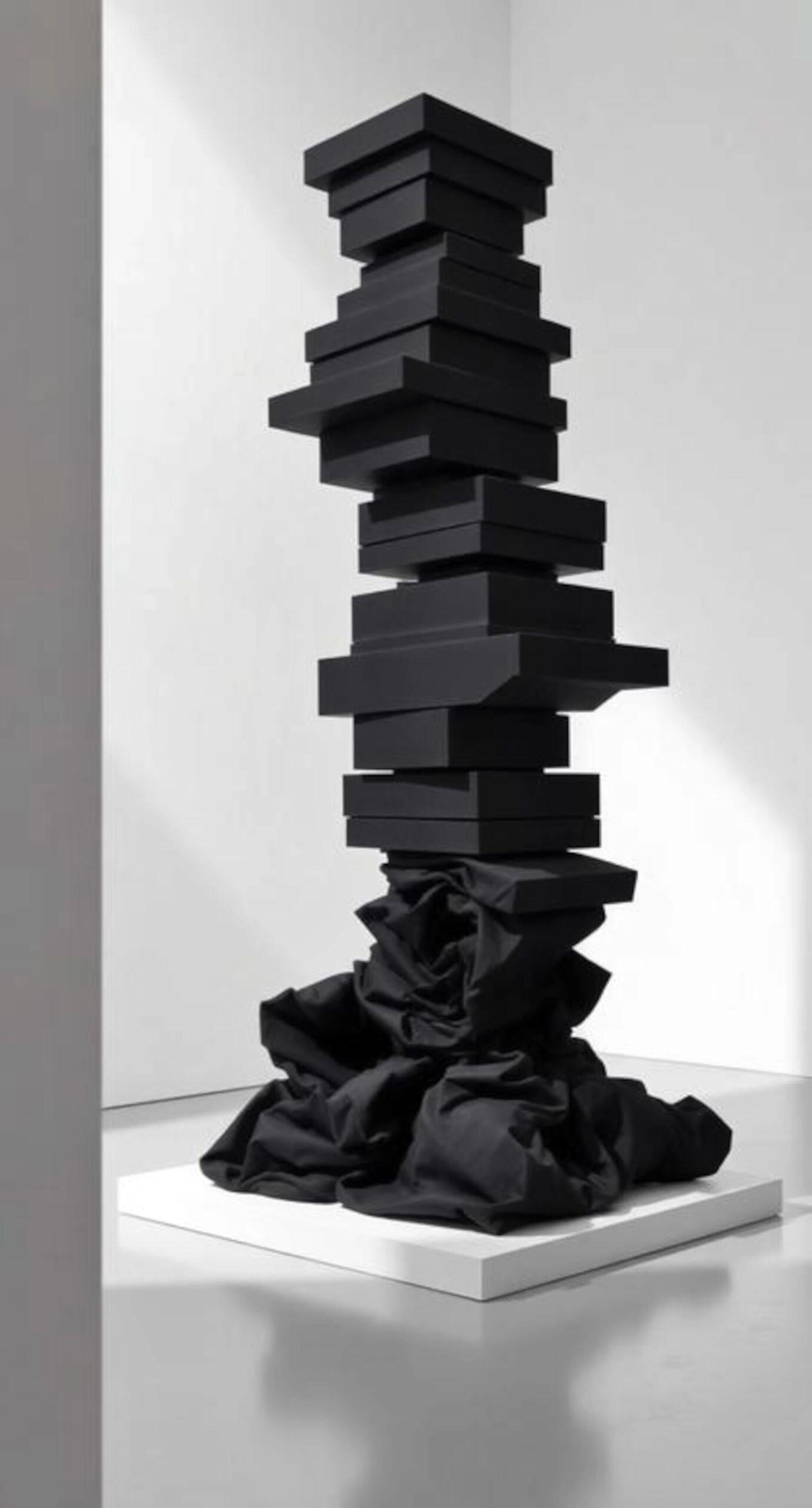
Assembler No. XXV — Column of Compression (2026)
Dimensions: 230 × 95 × 95 cm
Medium: Wood modules, internal steel armature, compressed textile, matte black pigment.
Wood modules, internal steel armature, compressed textile, matte black pigment
Column of Compression is constructed from a vertical sequence of rigid wooden modules held above a densely compressed mass of textile. The contrast between the geometric upper structure and the gathered material below makes the distribution of weight and pressure visible within the work.
The textile functions not simply as a contrasting material, but as a record of force. Compressed beneath the assembled modules, it appears to absorb, contain and resist the weight imposed upon it, while the rigid elements above maintain their ordered arrangement.
Within OPUS: THE ASSEMBLER, the work considers compression as a condition of assembly: elements are brought together, held in relation, and sustained through opposing forces. The resulting structure is neither entirely rigid nor entirely yielding, but suspended between the two.
Answering (2024)
Dimensions: 125 × 92 × 92 cm
Medium: High-density PUR foam over welded steel armature, GRP composite shell, matte polyurethane finish.
Answering is an early sculpture within OPUS: THE ASSEMBLER, constructed around a substantial opening in an otherwise enclosed, irregular volume. The aperture interrupts the continuity of the outer shell, exposing a recessed interior while maintaining the sense of a contained and resistant form.
The opening gives the sculpture an ambiguous spatial condition. It suggests access without providing entry; the interior becomes visible, yet remains physically inaccessible. The form therefore exists between enclosure and exposure, opening and containment.
The work establishes an important relationship with Containment: where Containment withholds its interior, Answering makes that interior visible. The two works approach the same problem from opposing positions, using the aperture not simply as an opening, but as a structural and perceptual event.
Within OPUS: THE ASSEMBLER, Answering examines what happens when an enclosed form is interrupted without being released from its condition of containment.


Convergence (2025)
Dimensions: 200 × 180 × 140 cm
Medium: Grouped Textile Vaults and High-Tension Rigging.
Convergence brings three large textile forms into sustained contact, each held under tension as it presses against the others. Their meeting produces a compressed central space in which the boundaries between individual forms become increasingly difficult to distinguish.
The work is defined as much by the spaces between the forms as by the forms themselves. Deep crevices interrupt the continuous surfaces, exposing areas of darkness and making the forces acting upon the structure visible through compression, contact and deformation.
Rather than presenting three independent volumes, Convergence creates a single unstable configuration in which each element depends upon the pressure exerted by the others. The work therefore becomes a study of how separate forms can remain distinct while simultaneously producing a collective body.
Plurality(2024)
Dimensions: 178 × 164 × 115 cm
Medium: PUR foam, welded steel armature, GRP shell, matte polyurethane
Plurality brings together multiple individual forms within a single sculptural configuration. From a distance, the separate volumes begin to read as one continuous body; closer inspection reveals the distinct forms, their individual contours and the spaces that separate them.
The work holds these two perceptions simultaneously: the unity of the whole and the persistence of its individual parts. Neither condition completely overrides the other. The sculpture remains both singular and multiple.
Within OPUS: THE ASSEMBLER, Plurality considers how separate elements acquire a collective identity through proximity, arrangement and structural relation. Assembly does not erase difference; it produces a new form through it.


Bearing (2026)
Dimensions: 196 × 85 × 65 cm
Medium: Sheet aluminum panels over steel truss armature, matte black polyurethane
Bearing is structured around a pronounced imbalance between mass and support. A substantial horizontal volume rests upon a narrow structural framework, creating the impression that the supporting elements are carrying a weight beyond their apparent capacity.
The contrast between the dense upper form and the exposed structural armature makes the distribution of weight central to the work. The framework does not disappear beneath the surface; it remains visible as the condition that allows the mass above it to be sustained.
The title Bearing refers simultaneously to the physical act of carrying weight and to the condition of enduring it. Within OPUS: THE ASSEMBLER, the work examines support as an active state of tension: to hold something in place is also to remain under its force.
Strata (2024)
Dimensions: 150 × 120 × 110 cm
Medium: Tiered Textile Layering
Strata is constructed through successive layers of textile that rise in an ordered vertical sequence before gradually losing their structural clarity. The work begins with the appearance of an assembled, geometric system, but the accumulation of material introduces compression, irregularity and deformation.
The distinction between structure and collapse remains unresolved. What has been assembled does not remain fixed; each layer bears the pressure of those above it, producing a form that appears increasingly unstable as it rises.
Within OPUS: THE ASSEMBLER, Strata considers assembly not as a final state, but as a process in which order, pressure and deformation continuously act upon one another.


The Burden of Memory (Opus: The Assembler)
Dimensions: 180 × 240 × 110 cm
Proposed Material: Proposed sheet aluminum pillars and hand-sculpted epoxy clay over steel truss armature
The Burden of Memory consists of two vertical structural supports carrying a substantial horizontal form whose surface appears to sag and deform beneath its own weight. The rigid geometry of the pillars contrasts with the irregularity of the mass they support, establishing a tension between structure and deformation.
The horizontal form appears neither fully suspended nor fully settled. It occupies a state between support and collapse, suggesting a weight that has accumulated rather than simply been placed upon the structure.
The title introduces a further dimension to this physical condition. Memory is understood not as something weightless or immaterial, but as something accumulated and carried. Within OPUS: THE ASSEMBLER, the work brings together support, weight and deformation in a structure that appears to endure what it carries.
Junction (2025 )
Dimensions: 165 × 110 × 85 cm
Medium: Black military-grade stretch textile over welded steel armature
Junction is constructed from a conical steel armature covered by a tensioned black military-grade textile skin. The form rises from a broad circular base before dividing into two symmetrical tubular extensions, producing a Y-shaped structure whose point of bifurcation becomes the central event of the work.
The textile obscures the underlying construction while remaining visibly shaped by it. At the junction, the material is drawn tightly around the branching structure, creating a compressed and deliberately ambiguous transition between the single lower form and its two extensions. The result is neither a conventional structural joint nor a purely organic division, but a form held between the two.
Within OPUS: THE ASSEMBLER, Junction considers the moment at which one structure becomes multiple. The point of connection is also a point of pressure: the place where continuity, separation and force meet.
Junction was featured on the cover of Art Market Magazine, Issue No. 111, March 2026.


Language ( 2024 )
Dimensions: 165 × 110 × 85 cm
Material: Pigmented polyurethane resin, steel wire armature, fiberglass.
Language is a dense, twisting form in which movement appears to have been arrested within a solid body. Its continuous folds and directional shifts suggest an action that has been stopped at a particular moment, leaving the form suspended between motion and stillness.
Unlike the suspended textile works within OPUS: THE ASSEMBLER, Language is fixed and self-contained. Its resin surface encloses the underlying armature, transforming a flexible structural language into a rigid volume.
As the only resin sculpture in the group, the work introduces a distinct material condition within the cycle. Its apparent solidity contrasts with the tension, suspension and compression of the textile works, while the twisting form retains the sense of movement that runs through the series.