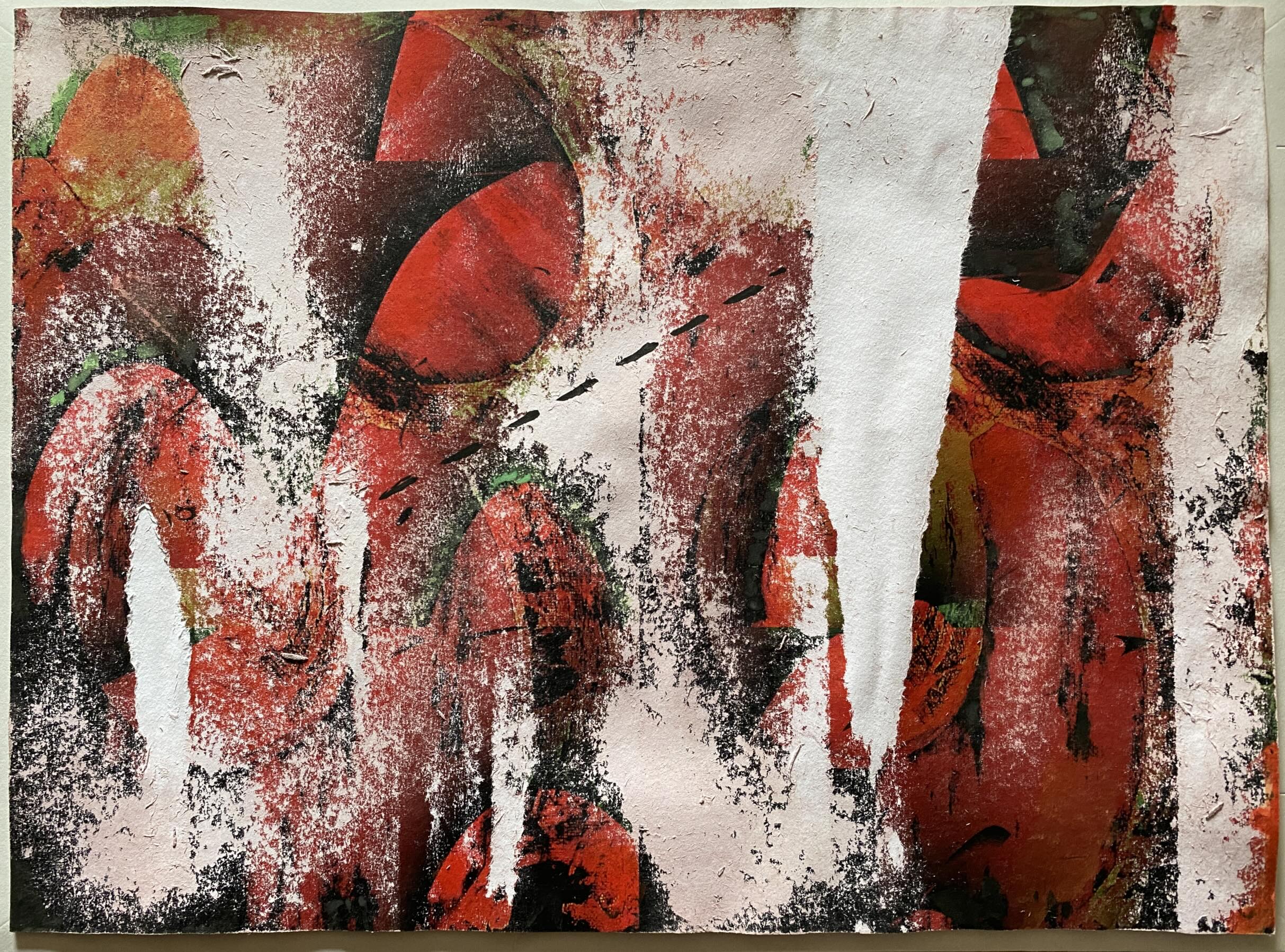
Looking for the Right Angle (No. 03)
- Title: Looking for the Right Angle
- Series: Aperture Set 1
- Artist: ZT Tosha
- Medium: Fine art print on Hahnemühle Photo Rag paper (40×30 cm), mixed intervention including tearing, sandpapering, and dashed lines applied in watercolor and black tempera; mounted on white mat paper and board; framed in black profile (50×40 cm).
- Year: 2026
Critical Overview: The Anatomy of Rupture
If Kriegsministerium (No. 01) established the series’ foundational vocabulary—the grid, the scratch, the tempera block—then Looking for the Right Angle (No. 03) represents the cycle’s first decisive physical departure. It is the first piece in the sequence to move beyond the surface of the print and actively damage the paper itself.
This piece does not merely depict a surface; it assaults it. Through a combination of deliberate tearing, aggressive sandpapering, and gestural dashes of pigment, the artist transforms the pristine Hahnemühle paper into a raw, wounded, and excavated terrain. It is a work that feels less like a composed image and more like a physical artifact of struggle—a map of a territory that has been violently contested.
Materiality: The Surface as a Battlefield
The foundational layer of Looking for the Right Angle is a dense, gritty print of deep earthy reds, burnt umbers, and charcoal blacks. The texture is not smooth; it appears almost like wet sand, rust, or dried biological tissue. It is a surface that carries the weight of history and decay.
However, this foundational layer is systematically dismantled through two distinct physical interventions:
- The Tears: Wide, jagged vertical strips of the paper are physically torn away, exposing the pristine white fibers of the paper beneath. These tears are not precise; they are violent, ragged, and jagged. They act as physical apertures—windows torn through the dense, earthy surface, allowing light and void to penetrate the composition. The stark contrast between the gritty red-black surface and the brilliant white of the torn paper creates a visual shock that is both immediate and unsettling.
- The Sandpapering: The surface is aggressively abraded with sandpaper, wearing away the printed pigment and revealing the raw, fibrous texture of the paper below. This intervention creates a mottled, eroded effect—as though the surface has been weathered by wind, water, or the friction of repeated touch. It introduces a tactile, sculptural quality to the print, transforming it from a flat image into a physical object that bears the marks of its own making.
The Gestural Interruption: The Dashed Line
Amidst the tears and the abrasive wear, the artist has applied a dashed black line—applied through a mixture of watercolor and black tempera—that cuts diagonally across one of the white torn strips.
This dashed line is the conceptual anchor of the piece. It is a tentative, searching gesture—a line that does not assert itself with confidence, but rather hesitates, pauses, and seeks. It functions as a visual compass, a brief moment of orientation amidst the chaos. The title Looking for the Right Angle becomes literal: the artist is not declaring a direction; he is searching for one.
The Framing Strategy: The White Mat as a Containment Vessel
As with the entire Aperture series, this piece is presented within a crisp white mat and a uniform 50×40 cm black frame.
The white mat is conceptually critical to this piece. Because the artwork itself is so aggressively torn, sanded, and excavated, the mat serves as a sterile container—a clinical frame that isolates the chaos and prevents it from bleeding into the viewer’s space. It transforms the violent, wounded surface into a preserved specimen, an archaeological artifact pinned and displayed in a museum vitrine.
Critical Honesty: The Vulnerability of the Torn Surface
A rigorous curatorial assessment must acknowledge the inherent fragility of this piece.
The tears in the paper, while visually powerful, render the artwork physically vulnerable. The edges of the torn paper are fragile and susceptible to curling, fraying, or further damage if not protected. Furthermore, the aggressive sandpapering has thinned the paper in certain areas, making it more susceptible to moisture and light damage.
For Looking for the Right Angle to achieve its full curatorial potential within a museum context, it is non-negotiable that the framing incorporates museum-grade, UV-filtering anti-reflective glass. This glass will not only protect the fragile, torn surface from environmental damage, but will also eliminate glare, allowing the viewer to appreciate the full depth of the torn layers and the subtle textures of the sandpapered areas.
The Role of the Piece in the Series (No. 03)
Positioned as No. 03 within the Aperture cycle, this piece serves as a pivotal early experiment. It follows the monochrome, grid-based aggression of Kriegsministerium (No. 01) and precedes the delicate, folded containment of Occlusion (No. 04).
It is the first piece in the sequence to fully embrace physical violence against the material. The tearing and sandpapering introduced here will become foundational techniques, revisited and refined in later works like Tear and Hatching.
By establishing this vocabulary of rupture so early in the cycle, the artist signals to the viewer that Aperture is not a series about flat, two-dimensional images. It is a series about the physical act of opening—of tearing through the surface to reveal what lies beneath.
Conclusion: A Search for Orientation
Looking for the Right Angle is not a comfortable work. It is raw, aggressive, and unapologetically physical. Yet, it is precisely this physicality that grants the piece its conceptual authority.
The combination of tearing, sanding, and gestural marking creates a work that feels both ancient and contemporary—a weathered artifact of a struggle that is both deeply personal and universally human. The dashed black line, searching for orientation amidst the chaos, becomes a profound metaphor for the human condition: the constant, uncertain search for the right angle, the right direction, the right path.
Acquisition Recommendation: Accepted.
Recommended display: Isolated on a neutral white or light-grey wall, illuminated by directional, angled gallery spotlights (800–1000 lux) to emphasize the depth of the torn layers and the textured surface. Museum-grade anti-reflective glass is strictly mandatory to protect the fragile, torn edges.
