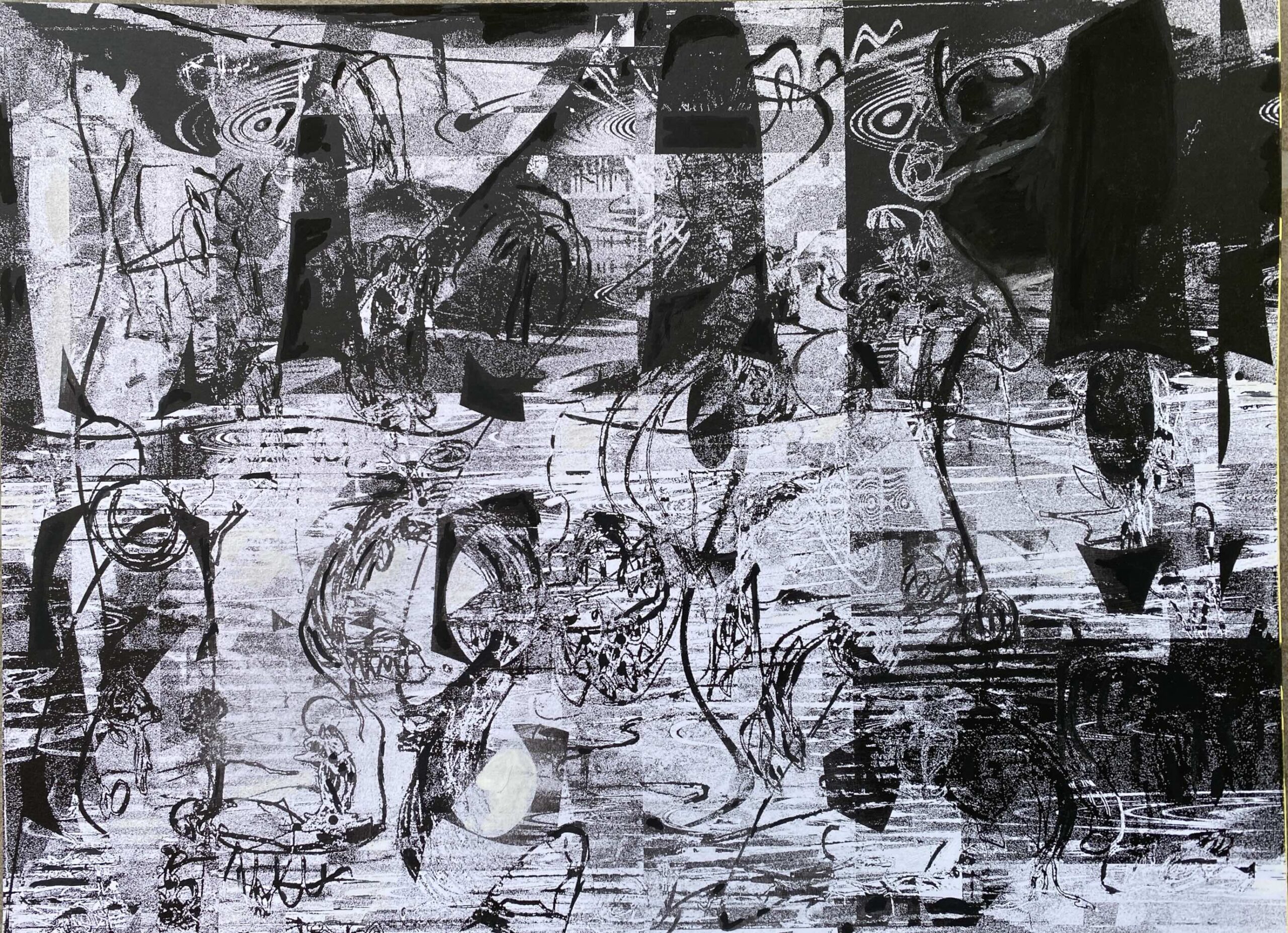
Kriegsministerium (No. 01)
- Title: Kriegsministerium
- Series: Aperture Set 1
- Artist: ZT Tosha
- Medium: Fine art print on Hahnemühle Photo Rag paper (40×30 cm), watercolor intervention, black tempera overlay, scratching and cut-out elements; mounted on white mat paper, framed in black profile (50×40 cm).
- Year: 2026
Critical Overview: The Genesis of the Archive
To acquire Kriegsministerium is to acquire the origin point of the Aperture cycle. As the very first artwork conceived and executed for this series, it carries the weight of a manifesto—a declaration of the formal, conceptual, and material principles that would come to define the subsequent seven pieces.
It is a work of immense visual density, unapologetic aggression, and archival gravity. It does not invite the viewer into a soothing landscape; it confronts them with a disorienting, fragmented map of bureaucratic violence.
The Title: A Historical Weight
The title Kriegsministerium (German for War Ministry) is not merely a descriptive label; it is a semantic weapon. It immediately situates the work within the realm of state power, bureaucracy, and institutionalized destruction. By titling a piece of abstract mixed media with this specific historical term, Tosha refuses to allow the artwork to exist in a purely formal, decorative vacuum. He forces the viewer to read the chaotic lines and slashes as the visual residue of a system designed for war.
Materiality: The Grid as a Prison
The foundational structure of Kriegsministerium is a rigid, fractured grid—a faint, architectural matrix of horizontal bands and vertical pillars. This grid appears as an underlying blueprint, a bureaucratic ledger, or a surveillance map. It provides the illusion of order.
However, this order is systematically eradicated by the artist’s interventions:
- The Tempera Invasions: Large, jagged, geometric masses of dense black tempera are applied directly over the grid. These shapes do not follow the architecture; they break it. They fall like heavy, shadowed monoliths, blocking the light and obscuring the underlying blueprint. They act as visual censor bars, redacting information.
- The Gestural Chaos: Overlaid upon the grid and the tempera is a frantic, looping, scribbled network of fine black line-work. These lines are not calculated; they are manic. They evoke the frantic scrawling of a distressed cartographer, or the static interference of a damaged communication line.
- The Cyclopean Motifs: Interspersed throughout the chaos are recurring circular, eye-like motifs. These “eyes” stare out from the static, suggesting a panopticon—a system that observes even as it destroys.
The Framing Strategy: The White Mat as a Clinical Void
In this presentation, the 40×30 cm Hahnemühle print is mounted on a crisp white mat and housed within a uniform 50×40 cm black frame.
This framing choice is conceptually critical. The white mat acts as a sterile, clinical container for the chaos. It isolates the image, turning the violent, scratched surface into a preserved specimen—a document pinned and labeled within a bureaucratic archive. The contrast between the pristine white border and the aggressive, monochrome interior creates a profound tension: the artwork is simultaneously a piece of evidence and a piece of destruction.
Critical Honesty: The Clarity of the Monochrome
Unlike the soft, luminous watercolors of Gazing or the ethereal scratching of Memory Surfacing, Kriegsministerium is a monochrome assault. The palette is restricted to black, white, and the ghostly grays of the printed grid.
This chromatic austerity is the work’s greatest strength and its greatest risk:
- Strength: The lack of color forces the eye to engage entirely with texture and line. The dense layering of tempera, scratching, and print creates a rich, tactile surface that demands close inspection.
- Risk: Under suboptimal lighting, the piece can visually collapse into a muddy, incomprehensible gray rectangle. The scratching is delicate, and the fine line-work is easily lost against the white grid.
For Kriegsministerium to be read correctly by a viewer, it requires high-contrast, directional gallery lighting (angled at approximately 45 degrees) to catch the physical ridges of the scratching and the matte, absorbent quality of the black tempera. Anti-reflective museum glass is strictly mandatory to prevent ambient light from flattening the tonal range.
The Role of the First Piece in the Series
As the very first work in Set 01, Kriegsministerium sets the tonal and conceptual stage for the entire Aperture cycle. It introduces the central visual vocabulary—the grid, the scratch, the tempera block, and the cut-out—that will evolve through the subsequent pieces.
It is the “genesis text” of the series. It establishes that this is not a collection of decorative prints, but a unified body of work dedicated to the excavation of hidden structures, the violence of bureaucracy, and the fragility of the printed image.
Conclusion: A Manifesto in Black and White
Kriegsministerium is not a comfortable artwork. It is dense, aggressive, and relentlessly monochrome. Yet, it is precisely this lack of comfort that grants the piece its conceptual authority. It announces the arrival of a serious, disciplined, and uncompromising artistic voice.
For a museum collection, this piece holds a unique historical significance: it is the first stone laid in the foundation of the Aperture cycle. It deserves to be displayed with the reverence granted to any foundational document.
Acquisition Recommendation: Accepted.
Recommended display: Isolated on a neutral white or light-grey wall, illuminated by directional, high-contrast gallery spotlights (800–1000 lux). The white mat must be allowed to breathe as a negative space container. Museum-grade anti-reflective glass is non-negotiable to preserve the delicate line-work.
