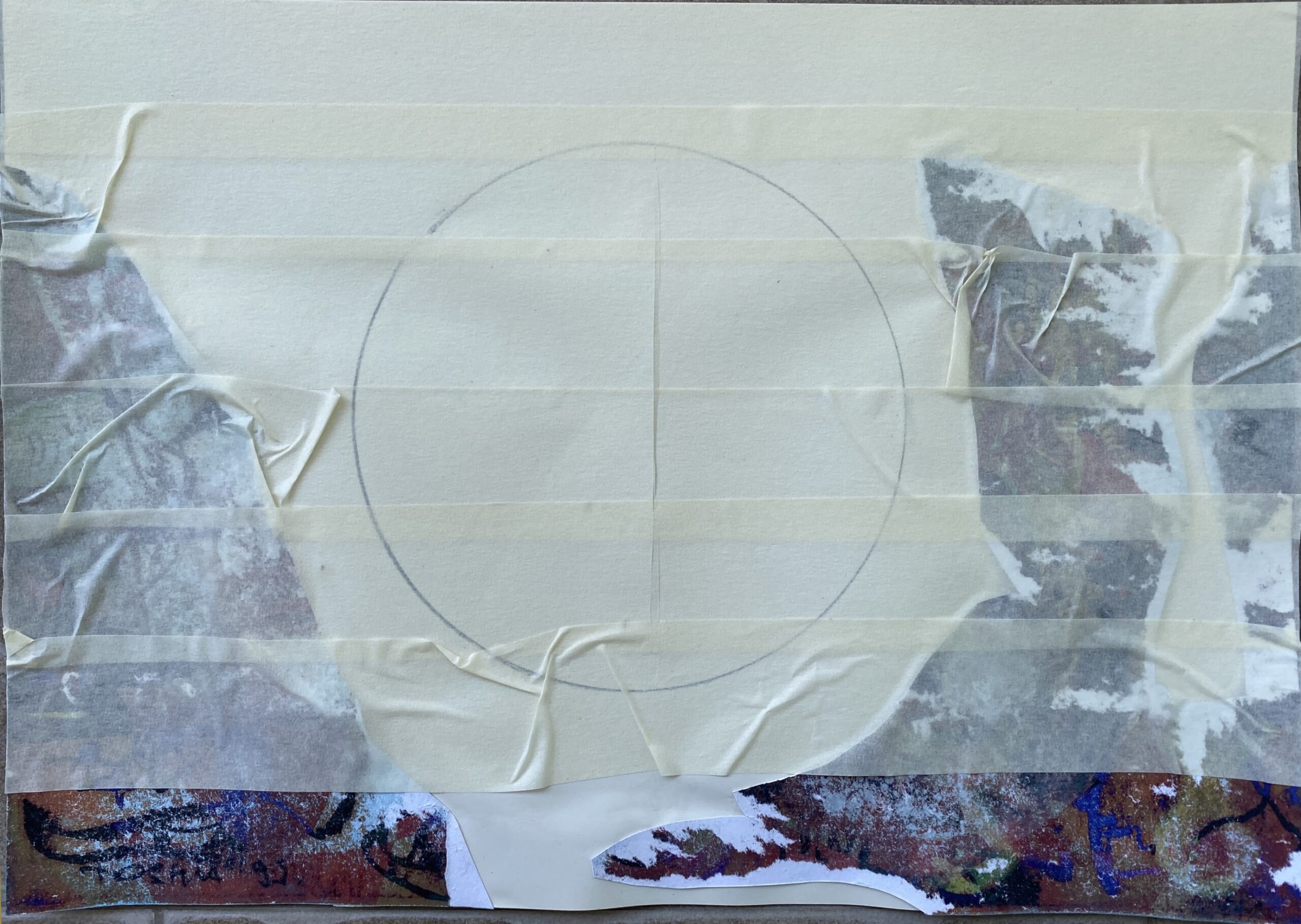
Occlusion (No. 04)
- Title: Occlusion
- Series: Aperture Set 1
- Artist: ZT Tosha
- Medium: Fine art print on Hahnemühle Photo Rag paper (40×30 cm), with interventions including sandpapering, water erosion, pencil drawing, semi-transparent tape overlay, and razor cut; mounted on white mat paper and board; framed in black profile (50×40 cm).
- Year: 2026
Critical Overview: The Architecture of Obscuration
If Looking for the Right Angle (No. 03) was the Aperture cycle’s first act of physical violence against the paper—a raw, tearing excavation of the surface—then Occlusion (No. 04) represents a radical pivot toward concealment.
This piece does not reveal; it blocks. It does not tear; it covers. Through a delicate, almost surgical layering of translucent materials, the artist constructs a visual barrier that simultaneously invites and denies the viewer’s gaze. The title is precise and unforgiving: Occlusion is the act of obstruction, the blocking of a passage, the closing of an aperture.
Materiality: The Censorship of the Translucent
The foundational layer of Occlusion is a dense, earthy print of muted reds, burnt umbers, and charcoal blacks—similar to the palette of Looking for the Right Angle, but here deliberately hidden.
This hidden layer is systematically obscured by a semi-transparent, pale cream tape or paper overlay that covers the majority of the composition. This overlay is not flat; it is heavily manipulated:
- The Horizontal Folds: The translucent surface is creased with deliberate, repeating horizontal folds. These folds create a rhythmic, blind-like texture, evoking the slats of a window blind or the ridges of a topographical map. They introduce a subtle, sculptural depth to an otherwise flat surface.
- The Wrinkled Edges: The edges of the overlay are crinkled, puckered, and physically distressed. These wrinkles suggest that the material has been aggressively handled, pressed, and unpeeled multiple times. They are traces of a physical struggle to apply and remove the obstruction.
- The Water Erosion: The surface of the overlay has been subjected to water erosion, causing the pale cream material to ripple, warp, and absorb moisture in irregular patches. This intervention softens the harshness of the folds, giving the piece a weathered, geological quality—as though the obstruction itself has been eroded by time and elements.
The Circular Motif: The Bisected Aperture
Dead center of the translucent overlay, the artist has drawn a delicate, fine-pencil circle. This circle is not perfectly symmetrical; it is slightly off-center, a subtle but critical deviation that introduces a sense of imbalance and human fallibility.
More importantly, the circle is bisected by a vertical razor cut that runs precisely through its center. This razor cut is a surgical intervention—a precise, clean incision that splits the circle in two. It functions as a literal aperture, a slit through the opaque overlay that allows a thin sliver of light and vision to penetrate the obstruction.
The combination of the off-center circle and the surgical bisection creates a powerful visual tension. The viewer is presented with a motif of geometric perfection (the circle) that has been simultaneously displaced and violated.
The Bottom Reveal: The Excavated Edge
At the very bottom edge of the composition, the translucent overlay is torn away, exposing a jagged, irregular strip of the dense, earthy print beneath. This torn reveal is not a mistake; it is a carefully controlled act of excavation.
This bottom edge provides the viewer with a critical visual anchor. It is the only point where the hidden layer is fully visible, offering a glimpse of the vibrant, chaotic surface that has been occluded by the pale overlay. It acts as a relief valve—a small aperture of clarity amidst the obstruction.
The Framing Strategy: The White Mat as a Clinical Void
As with the entire Aperture series, Occlusion is presented within a crisp white mat and a uniform 50×40 cm black frame.
The white mat is conceptually essential to this piece. Because the artwork itself is pale, translucent, and visually delicate, the white mat provides a necessary negative space that prevents the composition from bleeding into the wall. It isolates the pale cream tones, allowing the subtle pencil line and the razor cut to breathe. Without this containment, the work would risk appearing unfinished or fragile.
Critical Honesty: The Dependence on Light and Shadow
A rigorous curatorial assessment must acknowledge that Occlusion is fundamentally dependent on its lighting conditions.
The translucent overlay is not a flat color; it is a physical surface that interacts dynamically with light. Under flat, diffuse overhead gallery lighting, the delicate folds and wrinkles will appear flat, and the subtle pencil circle will recede into the pale cream background.
To activate the full visual spectrum of the work, the piece demands directional, angled spotlighting (at approximately 45 degrees). This angled light will cast micro-shadows from the horizontal folds and the crinkled edges, revealing the sculptural depth of the overlay. It will also catch the surface of the razor cut, creating a subtle shadow line that emphasizes the bisection of the circle.
Furthermore, the water erosion on the overlay creates subtle variations in opacity that will only become visible under controlled, diffused lighting.
Anti-reflective museum glass is non-negotiable. Standard reflective glass will bounce ambient light back into the viewer’s eyes, effectively flattening the delicate transparency of the overlay and destroying the subtle interplay of light and shadow.
The Role of the Piece in the Series (No. 04)
Positioned as No. 04 within the Aperture cycle, Occlusion serves as a critical moment of conceptual pause. It follows the aggressive tearing of Looking for the Right Angle (No. 03) and precedes the frantic scratching of Hatching (No. 05).
It is the only piece in the series that actively conceals rather than reveals. While other works tear, cut, and scratch to expose hidden layers, Occlusion deliberately builds a barrier, forcing the viewer to peer through the obstruction rather than into the surface.
This act of concealment is deeply resonant with the series’ title, Aperture. An aperture is an opening, a passage for light. Occlusion presents an aperture that has been deliberately closed—a lens that has been covered, a window that has been blinded. It is a meditation on the limits of vision and the politics of censorship.
Conclusion: The Poetry of Obstruction
Occlusion is a work of remarkable restraint and quiet power. It does not demand attention through aggression or color; it invites the viewer to look closely, to peer through the translucent barrier, and to engage with the subtle details of the surface.
The delicate pencil circle, slightly off-center and bisected by a razor cut, becomes a profound metaphor for the fragility of human perception. We are always attempting to draw perfect circles, to find perfect centers, to see clearly—yet we are always subject to occlusion, to obstruction, to the barriers that obscure our vision.
Acquisition Recommendation: Accepted.
Recommended display: Isolated on a neutral white or light-grey wall, illuminated by directional, angled gallery spotlights (800–1000 lux) to emphasize the micro-shadows of the folds and the subtle texture of the water erosion. Museum-grade anti-reflective glass is strictly mandatory to preserve the delicate transparency of the overlay and the subtle pencil line.
