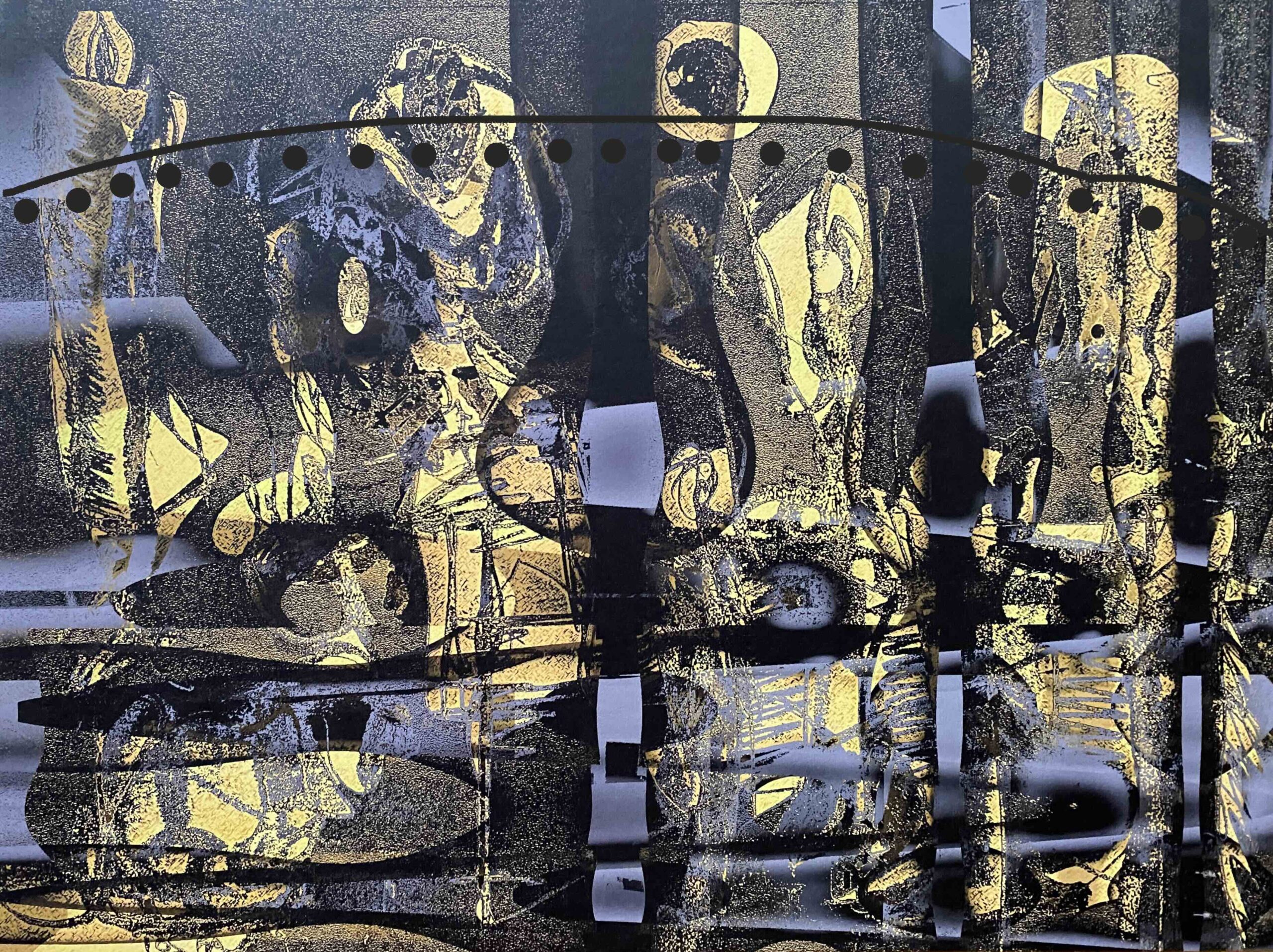
Tailoring (No. 07)
- Title: Tailoring
- Series: Aperture Set 1
- Artist: ZT Tosha
- Medium: Fine art print on Hahnemühle Photo Rag paper (40×30 cm), watercolor and black tempera mixed intervention, cut-out elements, physical scoring, and wax/pastel dot application; mounted on white mat paper and board; framed in black profile (50×40 cm).
- Year: 2026
Critical Overview: The Architecture of Measurement
If Kriegsministerium (No. 01) was the violent genesis of the Aperture cycle—a manifesto of bureaucratic chaos and monochrome aggression—then Tailoring (No. 07) represents a late-stage synthesis. It is the penultimate piece in the set, arriving after the biological explorations of Cell, the kinetic scratching of Hatching, and the pale vulnerability of Occlusion.
By the time the viewer encounters Tailoring, they have already witnessed a wide range of material interventions. This piece does not introduce a new vocabulary; it consolidates the vocabularies that came before. It marries the industrial grid of Kriegsministerium with the luminous metallic textures that have emerged throughout the cycle, creating a work of resolved, architectural precision.
The title is deliberately industrial and precise, evoking the craft of cutting, fitting, and constructing garments or architectural frames. Yet, beneath this surface of precision lies a chaotic, scratched, and hand-wrought interior.
Materiality: The Collision of the Metallic and the Organic
The foundational surface of Tailoring is a dense, textured print of deep charcoal gray and black, over which a striking, granulated metallic gold-yellow has been applied. This gold is not a flat paint; it possesses a gritty, sand-like texture, catching the light in unpredictable, granular bursts.
This metallic intervention creates a profound chromatic tension:
- The Gold: Reads as opulence, industry, metallic armor, and architectural illumination.
- The Charcoal/Black: Reads as shadow, corrosion, soot, and industrial decay.
The gold does not sit passively behind the grid; it is actively revealed through the scratched and scraped areas of the dark pigment, as though the artist is excavating a buried treasure from a bed of coal.
The Vertical Grid and the Horizontal Interruption
The composition is defined by a series of vertical, segmented strips—pillars or fabric swatches that run from top to bottom. These verticals provide a strict, rigid architectural framework.
However, this rigidity is immediately undermined by two specific horizontal interventions:
- The Sweeping Black Arc: A dark, sweeping arch stretches horizontally across the upper-middle section of the composition, threading through the vertical pillars. This arc does not follow the geometry of the grid; it overrides it. It acts as a measuring line, a tailor’s snap-line, or a taut thread pulled across the fabric of the artwork.
- The Underneath Arch of Black Dots: Directly beneath this arc, a precise, rhythmic series of black dots is scored or stamped into the surface. These dots act as a measurement scale—calibrating the arch, and grounding the sweeping gesture in a system of mathematical precision. The combination of the flowing arc and the rigid dots creates a perfect visual marriage of the gestural and the measured.
Cut-Outs and Physical Excavation
Interspersed throughout the vertical grid, and particularly along the lower horizontal bands, are rectangular cut-outs that expose the raw white backing paper and board beneath.
These cuts are not random; they are precise, geometric windows that function as ventilations within the otherwise dense, metallic surface. They allow the pristine white of the mat to bleed through, creating a conversation between the heavy, opaque surface of the print and the clean, airy void of the mounting. It is an aperture in its most literal form.
The Framing Strategy: The White Mat as a Dialectical Void
As with the entire Aperture series, Tailoring is presented within a crisp white mat and a uniform 50×40 cm black frame.
This framing strategy is essential to the work’s reception. The white mat isolates the metallic, gritty surface, preventing it from bleeding into the wall. It transforms the artwork into a specimen—an industrial artifact pinned and preserved within a sterile, clinical vitrine. The contrast between the matte white border and the textured, black-and-gold interior reinforces the conceptual tension between precision and chaos.
Critical Honesty: The Dependence on Light
A rigorous curatorial assessment must acknowledge that Tailoring is fundamentally dependent on its lighting conditions.
The metallic gold pigment is not a flat color; it is a reflective surface. Under flat, diffuse overhead gallery lighting, the gold will appear dull and muddy, and the intricate scratching will be lost. To activate the full visual spectrum of the work, the piece demands directional, angled spotlighting (at approximately 45 degrees). This angled light will catch the physical grains of the metallic pigment, causing the gold to shimmer, while simultaneously casting micro-shadows that reveal the depth of the scratching and the physical reality of the cut-outs.
Anti-reflective museum glass is non-negotiable. Standard reflective glass will bounce ambient light back into the viewer’s eyes, effectively destroying the metallic gleam and flattening the sculptural texture of the piece.
The Role of the Piece in the Series (No. 07)
Positioned as No. 07 within the Aperture cycle, Tailoring functions as a formal consolidation. It arrives after the viewer has experienced the full range of the artist’s material vocabulary—the torn paper of Tear, the delicate folds of Occlusion, the frantic scratching of Hatching.
Instead of introducing a new concept, Tailoring brings all of these earlier impulses into a single, resolved composition. It is the work of an artist who has fully mastered his craft, and is now demonstrating his ability to synthesize diverse elements into a cohesive, powerful image. It sets the stage for the final piece of the cycle, leaving the viewer with a sense of industrial completion and architectural closure.
Conclusion: The Measured Chaos
Tailoring is a work of deliberate paradox. It presents itself as a piece of precision engineering, yet its surface is scarred, scratched, and hand-wrought. It employs the language of measurement and construction, yet its ultimate effect is one of organic, industrial decay.
Positioned at the end of the Aperture cycle, it serves as a testament to the artist’s evolution—from the raw aggression of the first piece, to the refined, metallic precision of the seventh. It is a visual meditation on the act of making, and the tension between the plan and the execution.
Acquisition Recommendation: Accepted.
Recommended display: Isolated or paired on a neutral grey or white wall, illuminated by directional, angled gallery spotlights (800–1000 lux) to activate the metallic gold pigment. Museum-grade anti-reflective glass is strictly mandatory to preserve the shimmering texture and the delicate scratches.
